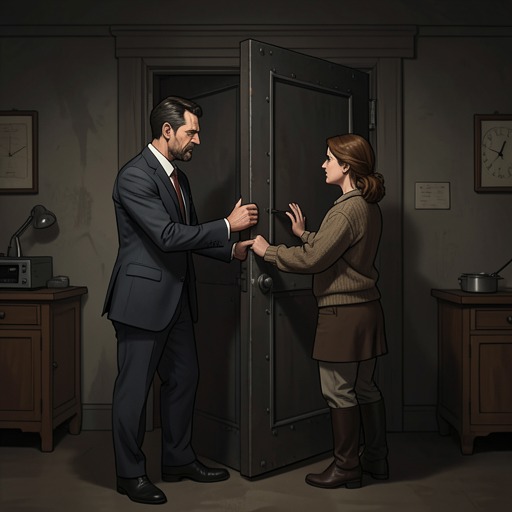
Hannah Winter
The Sun is Also a StarHannah Winter is the paralegal in Jeremy Fitzgerald’s law office, a woman who has imagined herself as a minor figure in someone else’s fairy tale until Jeremy becomes, in her eyes, her One True Love. Their romance is not a simple private happy ending: Jeremy is married with two young children, and his choice to spend an afternoon with Hannah means missing the court appointment that might have stopped Natasha Kingsley’s deportation. Hannah’s story joins romantic wish fulfillment to consequences that reach well beyond the couple.
Identity and First Appearance
Hannah first appears at work in Jeremy Fitzgerald’s unfinished office. The building is cold, the office only halfway constructed: its walls are partly painted, bare bulbs hang overhead, and sawdust and paint splatters lie across the tarped floor. In the midst of that makeshift setting, Hannah’s carefully arranged appearance seems almost staged. Her deep-black hair is perfectly styled; bright red lipstick and rose-rouged cheeks stand out against her pallor. Natasha Kingsley sees in her a secretary from an old-fashioned cartoon or a 1950s period film, an impression reinforced by the neat, color-coded files on her desk and a mug advertising that paralegals do it cheaper.
The office details give Hannah a defined professional identity before her romantic one is explained. She is at the desk, hands resting on the office phone as if willing it to ring. When Natasha approaches, Hannah offers a sad, trembling smile. Later, she formally guides Natasha to Jeremy’s office, correcting herself as she moves from his first name to a familiar shortening and then to his professional title. The small hesitation exposes the intimacy beneath the workplace manners: Hannah is not simply a staff member escorting a client, but someone whose connection to Jeremy is already visible to an observer.
A Fairy-Tale Role and Its Reversal
Hannah has always pictured herself as a supporting character in a fairy tale, not its princess, fairy godmother, villain, or villain’s familiar. She imagines a place near the edge of the story: perhaps a cook serving crumpets and sugarplums, perhaps a good-natured handmaiden who remains just out of view. The image makes her self-conception vivid and specific. She has not expected to occupy the plot’s center; she has assigned herself a modest role before anyone else can do so.
Working for Jeremy changes that imagined position. Hannah recognizes him as her One True Love and as the promise of a Happily-Ever-After, even though he is married and the father of two young children. The obstacles are not hidden from her fantasy; they are present in the very circumstances that make its fulfillment seem unlikely. She never believes Jeremy will return her love until the day he does. The narration marks the change with unusual compression: that day is the day of the story’s present. Her imagined romance moves suddenly from private conviction to mutual feeling, but the plot makes clear that being loved does not make its consequences disappear.
The Accident and the Affair
Jeremy’s change of heart follows a collision. While crossing the street, he is hit at twenty miles per hour by a drunk and distraught insurance actuary driving a white BMW. The impact does not kill him, but it makes him contemplate both his eventual death and the life he is currently living. In that reckoning, he admits to himself that he has been in love with Hannah for some time. The accident is therefore not merely a physical interruption: it precipitates an acknowledgment of a feeling that, by his own understanding, predates the day itself.
The relationship becomes an affair. When Natasha later meets Jeremy, she identifies the situation directly: he is a married man with two children and is having an affair with his paralegal. Jeremy says it began that day and ended that day, then looks toward his closed office door as if hoping Hannah will be there. In an earlier phone call, Hannah had answered with immediate alarm and tenderness, asking Jeremy whether he was all right. She explains that she wanted to come but had stayed to hold down the fort because his wife told her to. At the word wife, her eyes flick open; as she listens, her face flushes and her eyes brighten with happy tears. Her response makes her attachment unmistakable, while the reference to his wife keeps the boundary she is crossing in view.
The Office, Natasha, and the Cost of Choosing
Natasha sees the bond between Hannah and Jeremy before she knows its full history. When Hannah opens the office door, she and Jeremy look at one another with such mutual absorption that Natasha feels like an intrusion. Jeremy does not notice her standing there until she clears her throat loudly. Even then, his thanks to Hannah carries an intimacy Natasha reads as a declaration of love. Hannah’s role in the legal office and her relationship with its attorney occupy the same space, and the contrast between professional procedure and private desire becomes consequential.
Jeremy does not tell Daniel Jae Ho Bae the truth about his failure to stop Natasha’s deportation. He missed the appointment with the judge who could have reversed the Voluntary Removal because he was in love with Hannah and spent the afternoon with her at a hotel instead of appearing in court. The romance therefore has a consequence beyond Jeremy’s marriage: his choice helps close off a chance to change the outcome for Natasha. The narration links that failure to Daniel’s devastation, which Jeremy will remember vividly, including Daniel’s busted lip and bloodied shirt. The weight of that memory makes the affair’s cost part of its story rather than background to a private love plot.
Change and Narrative Significance
Afterward, Jeremy sits alone in his partially built office and thinks repeatedly of Daniel’s words about time and of the pain caused by Natasha’s departure. Within the next month, he tells his wife that he no longer loves her and that it will be best for her and the children if he leaves. He then calls Hannah, makes promises to her, and keeps them. The account moves from an impulsive afternoon and an apparent same-day ending to a consequential decision and a future commitment. Hannah’s fairy-tale expectation is not simply dismissed: Jeremy eventually acts on the love she had imagined, though the path there involves betrayal, missed legal intervention, and a family separation.
Hannah’s characterization is largely presented through the contrast between her self-image as a minor figure and the decisive place she comes to occupy in Jeremy’s life. The fairy-tale language gives shape to her longing, while the unfinished office, phone call, closed door, and missed appointment anchor that longing in material circumstances. Her romance is both a reversal of her expected role and a reminder that a private happy ending can carry public and familial costs. By the time Jeremy makes and keeps his promises, the story has established that Hannah’s becoming the star of her own imagined tale does not erase the lives altered along the way.